Dev frameworks
Playwright vs Cypress: Which Should You Use in 2026?
August 5, 2026 · 7 min read · Grabbit Team
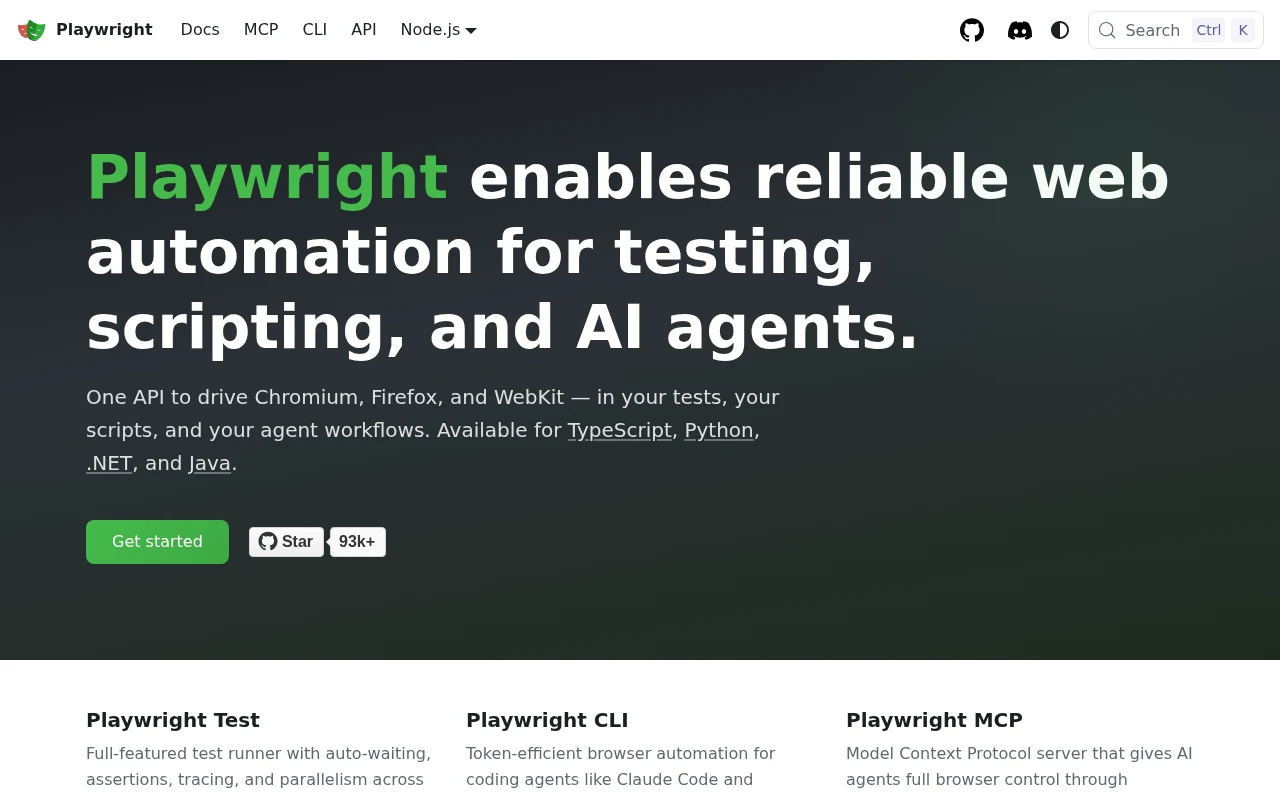
Playwright and Cypress are both strong end-to-end testing frameworks, and for many projects either one works. The short version: choose Playwright if you need cross-browser coverage (including Safari/WebKit), free parallel execution, or multi-tab and cross-origin flows; choose Cypress if you are a JavaScript-only team building a single-page app and you value its interactive time-travel runner and fast local feedback. This guide walks the real differences, gives a recommendation per project type, and covers the part both tools handle the same way in principle but differently in practice: screenshots.
The short answer
If you want a one-line decision rule:
- New project, cross-browser matters, CI-heavy suite → Playwright.
- Single-page app, Chromium-only, you want the smoothest local debugging → Cypress.
- Team already fluent in one of them, no hard blocker → stay where you are; both are actively maintained.
Everything below is the reasoning behind that rule.
Browser coverage
This is the biggest single difference. Playwright drives Chromium, Firefox, and WebKit natively, so you can run the same test across all three engines, WebKit being the closest practical stand-in for Safari. Cypress is Chrome-family first; it runs in Chromium-based browsers and Firefox, but it has no real WebKit/Safari support.
If "does it work in Safari?" is a question your team has to answer, Playwright answers it and Cypress does not. If you only ship to Chromium users, this difference does not affect you.
Speed and parallelization
Playwright controls the browser out-of-process over the DevTools protocol, while Cypress runs inside the browser's execution loop alongside your app. In practice Playwright tends to run large suites faster, and independent benchmarks put it ahead on raw execution.
The bigger practical gap is parallelization. Playwright shards tests across workers for free, out of the box. Cypress can parallelize too, but its optimal parallel execution and the run dashboard have historically been a paid Cypress Cloud subscription. For a large CI suite, that is a real cost line, not a footnote.
Language support
Cypress is JavaScript and TypeScript only. Playwright supports JavaScript, TypeScript, Python, Java, and .NET. If your backend team writes tests in Python or your org standardizes on C#, Playwright lets them share one tool. For a pure JS/TS shop this is a non-issue.
Multi-tab, multiple origins, and iframes
Cypress runs in a single-origin browser sandbox. That design gives it a lot of its ergonomics, but it makes multi-tab flows, cross-origin navigation, and some iframe interactions awkward or unsupported. Playwright handles multiple tabs, multiple browser contexts, and cross-origin navigation natively.
If your tests cross domains, open new tabs (OAuth popups, payment redirects), or juggle several user sessions at once, Playwright removes a class of friction here.
Developer experience and debugging
This is where Cypress earns its loyalty. The interactive time-travel runner lets you step back through each command and see the app's state at every point, and automatic waiting makes tests read cleanly without manual sleeps. For local development on a single-page app, many developers still find Cypress the more pleasant tool.
Playwright has closed most of the gap with its Trace Viewer, UI mode, and codegen, and its expect auto-retries similarly to Cypress. The debugging experience is now excellent on both; Cypress's edge here is narrower than it was two years ago.
Cost
Both frameworks are open source and free to run yourself. The costs show up at scale:
- Cypress: parallel test orchestration and the dashboard are a paid Cypress Cloud plan.
- Playwright: parallelization is free, but you still pay for CI minutes and for maintaining the browser binaries your runners download and update.
Neither cost is the framework license. Both are the operational tax of running real browsers in CI, which is worth keeping in mind for the screenshot section below.
A quick decision table
| Requirement | Playwright | Cypress |
|---|---|---|
| Chromium, Firefox, WebKit/Safari | Yes, all three | Chromium-family, no WebKit |
| Free native parallelization | Yes | Paid (Cypress Cloud) |
| Languages | JS, TS, Python, Java, .NET | JS, TS only |
| Multiple tabs / cross-origin | Native | Restricted |
| Interactive time-travel runner | Trace Viewer / UI mode | Yes, its signature feature |
| Best fit | Cross-browser, CI-heavy, polyglot teams | JS single-page apps, local-first |
Where both frameworks agree: screenshots for UI verification
Both Playwright and Cypress can take screenshots, and both do it well for the app under test. cy.screenshot() in Cypress and page.screenshot() in Playwright each capture what the runner controls, and both auto-capture on failure so you get evidence when a test breaks. For an in-suite capture of your own app, use the framework you already picked. For the Cypress specifics see how to take screenshots in Cypress; for Playwright see how to take screenshots in Playwright.
Two capture jobs sit outside what either framework is built for:
- Capturing a URL your test suite does not control. A third-party page, a partner's site, or your own production URL. Cypress restricts cross-origin navigation, and pointing a whole Playwright run at an external site just to grab one image is heavy.
- Consistent renders across environments. A screenshot's fonts, emoji, and anti-aliasing depend on the OS the browser runs on. A shot from your macOS laptop and one from a Linux CI runner differ, which produces false diffs in visual regression testing. Baselines need one fixed rendering environment.
For both jobs, a hosted screenshot API captures a URL from a fixed environment and returns an image, so you skip provisioning and maintaining a browser for that one task. Here is the same "capture a page" idea as a single request to Grabbit:
curl https://api.grabbit.live/v1/grabs \
  -H "Authorization: Bearer sk_live_..." \
  -H "Content-Type: application/json" \
  -d '{
    "url": "https://example.com/pricing",
    "width": 1280,
    "height": 720,
    "full_page": true,
    "format": "webp"
  }'
The response includes a hosted image_url you can archive or diff:
{
  "id": "grb_01jx...",
  "status": "done",
  "image_url": "https://cdn.grabbit.live/grabs/grb_01jx....webp",
  "width": 1280,
  "format": "webp",
  "bytes": 52340,
  "execution_ms": 1240
}
The options you know from either framework map across directly. A full-page capture becomes "full_page": true, an element capture becomes a "selector" field, and any wait you would add before a shot becomes "delay_ms" (0 to 10000). Width accepts 320 to 1920, height 240 to 1080, and "format" is "png", "jpeg", or "webp".
# capture one component from a live URL, after it settles
-d '{
  "url": "https://example.com/dashboard",
  "selector": "[data-testid=chart]",
  "delay_ms": 800,
  "format": "png",
  "width": 1280,
  "height": 720
}'
Grabbit is prepaid at $0.002 per live grab, and credits do not reset or expire monthly, so an occasional external capture in CI does not carry a subscription's worth of overhead. Test-environment keys return free placeholder images, so you can wire it up before adding a card.
The bottom line
Playwright has the momentum, and for cross-browser, CI-heavy, or polyglot projects it is the clearer pick in 2026. Cypress is far from obsolete: for a JavaScript single-page app where local debugging experience matters most, it is still an excellent choice. Pick on your actual requirements, browser targets, parallel scale, languages, and multi-origin needs, not on which framework is trending.
Whichever you choose, when you need to screenshot a URL your suite does not control or produce a consistent baseline from a fixed environment, reach for a screenshot API instead of bending your test runner to do it. For choosing a hosted service honestly, the screenshot API comparison weighs the trade-offs.
FAQ
- Why are people transitioning from Cypress to Playwright?
- The three most common reasons are cross-browser coverage (Playwright drives Chromium, Firefox, and WebKit natively, while Cypress is Chrome-family first), free parallel execution (Playwright shards across workers out of the box, while Cypress parallelization historically needed a paid Cypress Cloud plan), and multi-tab and cross-origin flows that Cypress's in-browser architecture restricts. Teams with large suites or Safari requirements tend to move; teams happy on a single Chromium target often stay.
- Will Playwright replace Cypress?
- Not entirely. Playwright has taken the momentum on new projects, especially cross-browser and CI-heavy ones, but Cypress remains a strong choice for JavaScript-only teams who value its interactive time-travel runner and quick local feedback. Both are actively maintained. Choose on your requirements, not on which is 'winning.'
- Why choose Playwright over Cypress?
- Pick Playwright when you need real cross-browser testing including WebKit/Safari, free native parallelization, multiple tabs or origins in one test, or language support beyond JavaScript (it also supports TypeScript, Python, Java, and .NET). Its out-of-process architecture avoids the in-browser sandbox limits that make some flows awkward in Cypress.
- Is Cypress still relevant?
- Yes. Cypress is still a well-maintained, widely used end-to-end runner with an excellent developer experience for single-page apps on Chromium. Its interactive runner, automatic waiting, and time-travel debugging remain a genuine advantage for local development. It is less suited to cross-browser and multi-origin testing, which is where teams reach for Playwright.
- What is better than Cypress for cross-browser testing?
- Playwright is the usual answer for cross-browser work because it drives Chromium, Firefox, and WebKit from one API. Selenium covers the broadest set of languages and real browsers if you need that. For the specific job of capturing a consistent screenshot of a URL from a fixed environment, a hosted screenshot API is simpler than running any of these in CI.
- Does Cypress or Playwright cost money?
- Both frameworks are open source and free to run yourself. The costs appear at scale: Cypress's cloud parallelization and dashboard are a paid subscription, while Playwright's parallel sharding is free but you still pay for the CI minutes and the maintenance of the browser binaries. Neither cost is the framework license itself.
Capture any website with one API call
Get a free test key and capture your first screenshot in two minutes.
Written by
Grabbit Team
Screenshots as a service
The team behind Grabbit, the screenshot API for developers and AI agents. We write about web capture, rendering, and automating screenshots at scale.
Keep reading
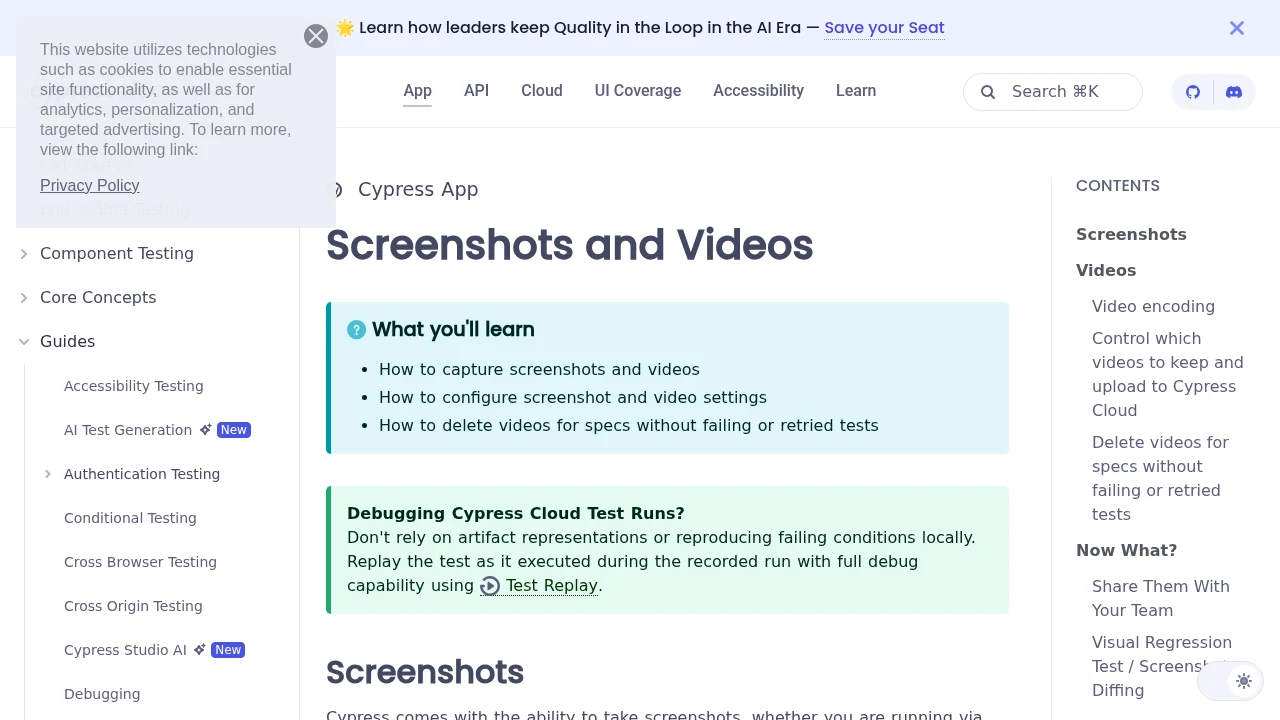
How to Take Screenshots in Cypress (and When to Reach for an API)
Capture screenshots in Cypress with cy.screenshot(): manual shots, full-page captures, elements, automatic on-failure images, and where they get saved. Plus the captures Cypress cannot do, and when an API fits.
Jul 12, 2026 · 5 min read
How to Take Screenshots in Playwright (Full Page, Elements, CI)
Everything you need to take screenshots in Playwright: the viewport default, full-page captures, element-level shots, and wiring it all into CI. Plus when to reach for an API instead.
Jun 14, 2026 · 10 min read
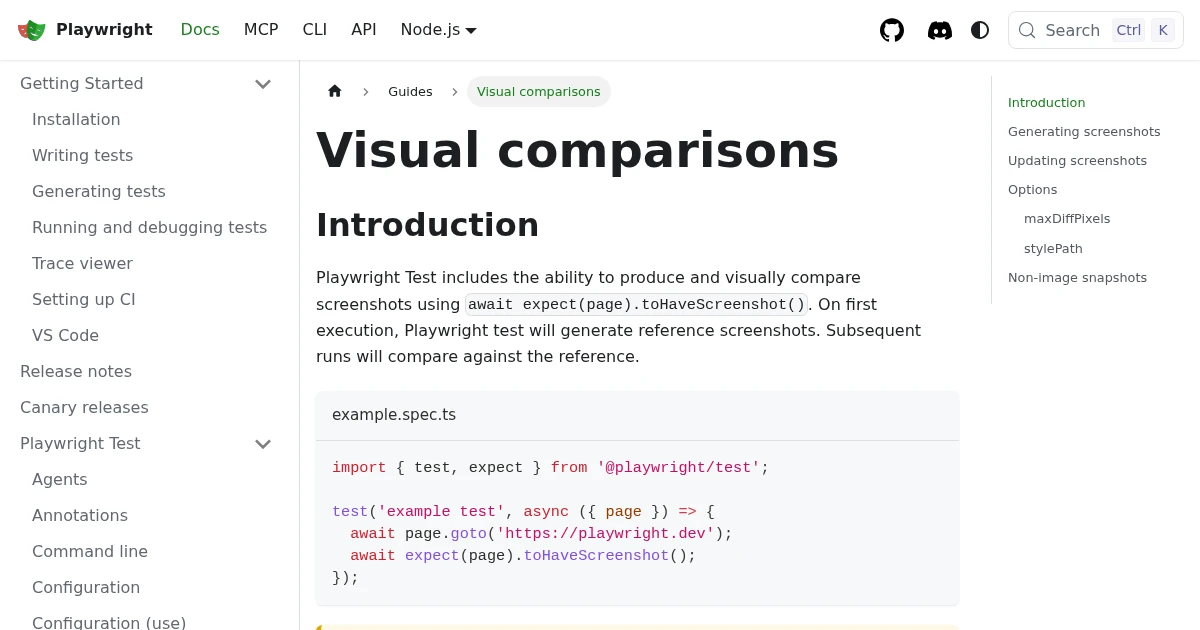
Playwright Visual Regression Testing: Catch UI Bugs in CI
Set up visual regression testing in Playwright with toHaveScreenshot: baselines, diff thresholds, the CI flake problem, and where a screenshot API fits as a stable baseline source.
Jun 17, 2026 · 5 min read